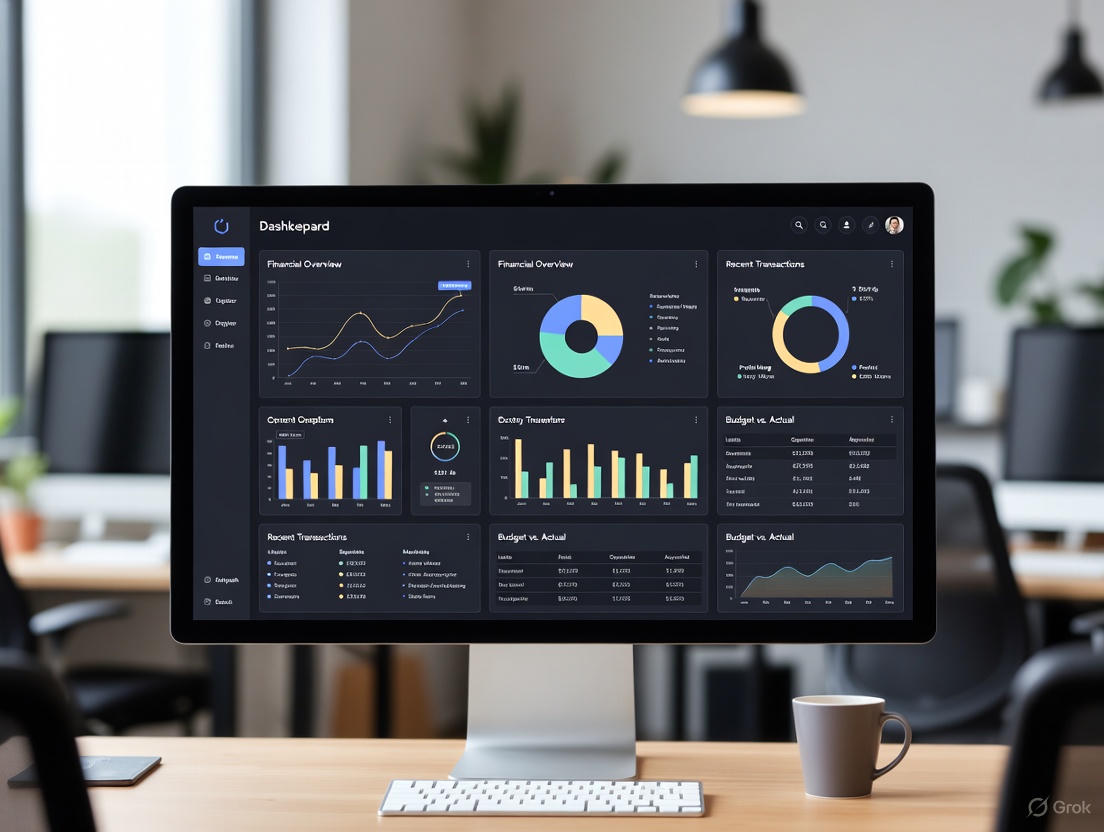
Accounting has always been the backbone of every business, but in 2025, the financial landscape is transforming faster than ever. With rapid advancements in artificial intelligence, companies are relying heavily on AI accounting tools to automate bookkeeping, improve accuracy, analyze data, and forecast financial trends.
From small businesses to global enterprises, AI-powered accounting systems have become essential for managing complex financial operations with efficiency and precision. This article explores the top AI accounting tools for 2025, automated accounting tools, smart finance solutions, AI financial forecasting, AI auditing tools, accounting automation 2025, best AI finance software, business accounting AI, future of accounting technology and their features, benefits, challenges, and how they are reshaping the future of finance.
What Are AI Accounting Tools?
AI accounting tools are intelligent software systems that use machine learning, predictive analytics, natural language processing, and automation to perform accounting tasks traditionally handled by humans.
These tools streamline processes such as:
- Bookkeeping
- Invoice management
- Payroll processing
- Tax calculations
- Financial forecasting
- Fraud detection
- Accounts payable and receivable
- Audit support

Unlike traditional accounting software, AI-driven tools learn from data, adapt to patterns, detect anomalies, and continuously improve their accuracy.
Why AI Accounting Tools Are Essential in 2025
The accounting industry is facing increased pressure from expanding regulations, global transactions, remote work, and rising cybersecurity threats. AI accounting tools help businesses overcome these challenges by providing:
1. Real-Time Financial Insights
Instead of waiting for month-end reports, AI offers instant performance metrics.
2. Higher Accuracy & Fewer Errors
AI dramatically reduces human error in data entry and reconciliation.
3. Faster Processing of Financial Data
AI can process large volumes of receipts, invoices, and ledgers in seconds.
4. Cost Savings
Companies cut costs by reducing manual labor and avoiding compliance mistakes.
5. Enhanced Security
AI detects fraud patterns and prevents suspicious transactions.
6. Better Decision-Making
Predictive analytics help businesses plan future strategies with confidence.
Top AI Accounting Tools in 2025
Below are the leading AI-powered accounting tools reshaping finance this year.
1. QuickBooks AI 2025
QuickBooks remains one of the most widely used accounting solutions, with its 2025 AI update delivering powerful automation features.
Key Features:
- Automatic categorization of expenses
- Smart invoice predictions
- AI-powered cash flow forecasting
- Real-time anomaly detection
- Automated reconciliation
Why It Stands Out:
Its accessibility and strong integrations make it ideal for small and medium-sized businesses.
2. Xero Intelligent Accounting
Xero continues to evolve with strong AI functionalities in 2025.
Key Features:
- AI invoice scanning & auto-completion
- Real-time financial performance insights
- Smart bank rules and reconciliation
- Predictive cash-flow modeling
- AI-driven payroll adjustments
Why It Stands Out:
Xero’s clean interface and powerful automation tools make accounting efficient and user-friendly.
3. FreshBooks AI
FreshBooks enhances its software with AI-driven financial intelligence.
Key Features:
- Automated time tracking for billing
- AI invoice follow-ups
- Smart revenue analytics
- Expense categorization and suggestions
- Project profitability forecasting
Why It Stands Out:
Perfect for freelancers, consultants, and small teams needing simplicity combined with automation.
4. Zoho Books Smart AI
Zoho Books leverages Zoho’s AI assistant, Zia, to enhance financial automation.
Key Features:
- AI-powered business insights
- Automated reminders and notifications
- Predictive financial reports
- Fraud detection alerts
- Smart expense tracking
Why It Stands Out:
It integrates seamlessly with Zoho’s full business suite.
5. Sage Intacct AI Suite
Sage has become a leader in enterprise-level AI accounting.
Key Features:
- Intelligent general ledger
- Multi-dimensional data analysis
- AI-driven approvals and workflow automation
- Revenue recognition automation
- Compliance monitoring
Why It Stands Out:
Ideal for complex enterprise operations requiring advanced financial intelligence.
6. Wave Accounting AI
Wave is popular among freelancers and small businesses for its free accounting features enhanced with AI.
Key Features:
- AI-powered receipt scanning
- Automated categorization
- Predictive cash analysis
- Smart invoice reminders
Why It Stands Out:
Budget-friendly and optimized for solo entrepreneurs.
7. Vic.AI Autonomous Accounting
Vic.AI is one of the first tools to introduce fully autonomous accounting, reducing the need for human intervention.
Key Features:
- AI invoice processing
- Autonomous approvals
- Deep machine learning models
- Real-time audit trails
Why It Stands Out:
It significantly increases speed and accuracy for AP (Accounts Payable) teams.
8. BlackLine AI Automation
BlackLine is widely used by enterprises for closing books and financial analysis.
Key Features:
- Automated reconciliations
- Risk scoring
- AI-driven compliance
- Intelligent workflows
Why It Stands Out:
Best for large organizations needing precision and automated reporting.
How AI Accounting Tools Improve Business Operations
AI-powered accounting tools are fundamentally improving businesses in several ways:
1. Automated Data Entry
Manual data entry is eliminated, speeding up accounting processes.
2. Streamlined Workflows
AI assigns tasks automatically, ensuring smoother operations.
3. Smart Document Processing
Invoices, receipts, and contracts are read and interpreted instantly.
4. Better Tax Management
AI identifies tax-saving opportunities and compliance risks.
5. Improved Cash Flow Management
Predictive analytics help businesses optimize spending.
6. Real-Time Auditing
Automated audit trails and monitoring simplify annual reviews.
Future Trends in AI Accounting (Beyond 2025)
Accounting is rapidly evolving—here’s what the next decade may bring:
1. Fully Autonomous Bookkeeping
AI tools will perform nearly all bookkeeping tasks independently.
2. AI-powered Virtual CFOs
AI will provide financial strategy insights previously offered by CFOs.
3. Emotional AI in Customer Billing
AI tools will adapt communication tone based on customer behavior.
4. Blockchain-Integrated Accounting
Secure and transparent financial ledgers will become the norm.
5. Voice-Activated Accounting Systems
Professionals will interact with accounting software via voice commands.
6. Advanced Fraud Prevention
AI will detect financial crimes in real time with near-total accuracy.
Challenges of AI Accounting Tools
AI accounting tools come with some challenges:
1. Implementation Costs
High-end solutions can be expensive for small businesses.
2. Data Privacy Concerns
Sensitive financial data requires strong cybersecurity.
3. Overdependence on Automation
Businesses may rely too heavily on AI and overlook errors.
4. Need for Staff Training
Teams must learn to operate and interpret AI-driven data.
5. Integration Issues
Legacy systems may not easily integrate with modern AI tools.
FAQs About AI Accounting Tools 2025
1. What are AI accounting tools?
They are intelligent software solutions that automate bookkeeping, analytics, invoicing, tax management, and forecasting.
2. How does AI help accountants?
AI reduces data-entry tasks, improves accuracy, detects fraud, and provides insights for better decision-making.
3. Are AI accounting tools expensive?
Some enterprise tools are costly, but many affordable and free AI-powered solutions exist for small businesses.
4. Can AI replace human accountants?
AI automates routine tasks, but accountants are still essential for strategy, interpretation, and complex decision-making.
5. What is the best AI accounting tool in 2025?
Popular options include QuickBooks AI, Xero Intelligent Accounting, Sage Intacct, and Vic.AI.
6. Is AI safe for financial data?
Yes, when equipped with strong encryption and cybersecurity protocols.
7. What industries benefit most from AI accounting?
E-commerce, finance, healthcare, real estate, retail, and professional services.
Conclusion
AI accounting tools in 2025 are redefining the future of finance. Businesses that adopt these tools gain faster processing, improved accuracy, real-time financial visibility, and significant cost savings. Whether you’re a small business owner, a startup founder, or an enterprise financial leader, AI-powered accounting will become essential for staying competitive in the evolving market.
As AI continues to grow, the accounting landscape will move toward complete automation, predictive decision-making, and intelligent auditing—ushering in an era of smarter, more efficient financial management.