Owning a swimming pool is one of life’s great luxuries, but only if the water is clean, safe, and inviting. Proper swimming pool maintenance isn’t difficult, but it does require consistency and an understanding of the science behind pool care.
Water Chemistry
Perfect water balance prevents algae, protects equipment, and keeps swimmers comfortable. Key parameters for perfect water balance and ideal ranges are below:
- Free Chlorine (2.0–4.0 ppm): Primary sanitizer; low → algae/cloudy water; high → eye irritation
- Combined Chlorine (0 ppm-max 0.5 ppm): Chloramines cause odor & irritation
- pH (7.4–7.6): Too low>corrosion, stinging eyes; Too high>scaling, cloudy water
- Total Alkalinity (80–120 ppm): Buffers pH swings
- Calcium Hardness (200–400 ppm): Prevents corrosion (vinyl/fiberglass lower: 150–250)
- Cyanuric Acid (outdoor:30–50 ppm, indoor: 0–20 ppm): Protects chlorine from UV degradation
- Total Dissolved Solids (<1500 ppm): High TDS reduces sanitizer efficiency.
- Phosphates (<150 ppb): Algae food source
- Metals (0 ppm): Cause staining and discoloration
Testing Frequency
- At least 2–3 times per week in peak season
- Daily, when temperatures exceed 90 °F (32 °C)
- After heavy use or rain
Recommended test kits for pool: Taylor K-2006 (liquid reagents, most accurate) or high-quality test strips (e.g., LaMotte ColorQ or AquaChek TruTest digital reader).
Chemical Adjustment Order
- Total Alkalinity
- Calcium Hardness (only if very low/high)
- pH
- Sanitizer (chlorine/bromine)
- Cyanuric acid
Sanitation Systems Compared
| SYSTEM | COST | PROS | CONS |
| Chlorine | $60–120/month | Cheap, widely available, very effective | Chlorine smell, stabilizer buildup |
| Saltwater Chlorine Generator (SWG) | $900–2,200 install | Softer feel, automatic, lower ongoing cost | High upfront cost, cell replacement every 3–7 yrs |
| Bromine | $100–150/month | Better in hot water (spas), less odor | More expensive, slower to activate |
| Biguanide (Baquacil, SoftSwim) | $200–300/month | Chlorine-free, gentle on skin | Very expensive, prone to pink slime |
| Mineral Systems (Nature2, Frog) | $150–300 initial | Reduces chlorine need 50–80% | Still requires some chlorine |
| UV + Ozone | $800–2,000 install | Kills pathogens chlorine misses | Does NOT provide residual sanitation |
Filtration & Circulation
Your filter and pump are the heart and lungs of the pool.
- Minimum 8–12 hours/day in summer
- Turnover rate: entire pool volume filtered at least 1–2 times daily
- Variable-speed pumps save 60–80% electricity vs single-speed
Sand (20–40 microns):
Pros: Backwash, Low cost, simple
Cons: Wastes water, least efficient
Cartridge (10–20 microns):
Pros: Hose off or replace, Excellent clarity, water-saving
Cons: Higher replacement cost
Diatomaceous Earth (2–5 microns):
Pros: Backwash + recharge, Best clarity
Cons: Most labor, DE powder is messy
Daily & Weekly Maintenance of Pool
Daily
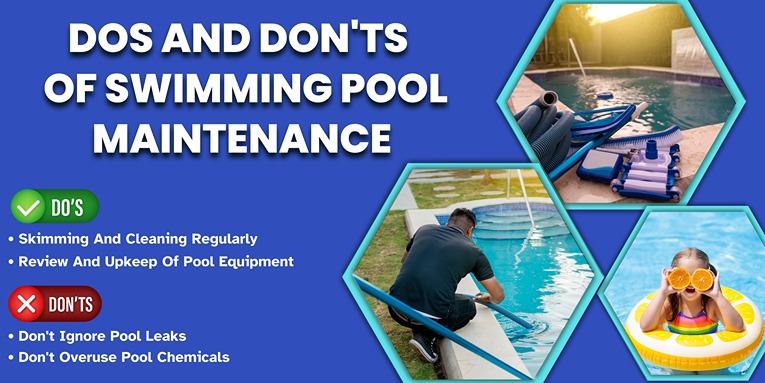
- Skim surface debris
- Empty skimmer baskets & pump strainer
- Quick visual check of water clarity & equipment
- Test & record chlorine and pH (in peak season)
Weekly
- Brush walls, steps, and behind ladders
- Vacuum pool (manual, suction, pressure, or robotic)
- Full water chemistry test
- Shock pool (if needed)
- Clean filter pressure gauge check & backwash/clean cartridge if pressure rises 8–10 psi above clean
Monthly
- Inspect and lubricate O-rings
- Clean salt cell (if applicable)
- Test cyanuric acid and phosphates
- Deep-clean waterline tile with enzyme cleaner
Shocking (Oxidizing) the Pool
Destroy chloramines, organic contaminants, and restore clarity.
- After a heavy batch load (parties)
- After rainstorms
- When combined chlorine >0.5 ppm
- Visible algae or cloudy water
Types of shock:
- Calcium Hypochlorite (Cal-Hypo 65–73%)
- Sodium Hypochlorite (liquid chlorine 10–12.5%)
- Dichlor (stabilized)
- Non-chlorine (MPS)
Algae Prevention & Treatment
Best algaecides for pools: 60% polyquat, copper-based (use cautiously), or sodium bromide + chlorine for conversion to bromine bank.
- Green: Anywhere, cloudy water ; Treat by Triple-shock + algaecide + brush
- Yellow/Mustard: On shaded areas, steps; Treat by Brush aggressively + mustard algaecide
- Black: On Plaster cracks, grout; treat by Brush with stainless brush + trichlor tabs directly on spots
- Pink: Not true algae (bacteria); treat by Biguanide failure or low sanitizer
Seasonal & Special Maintenance
Opening the Pool (Spring)
- Remove, clean, and store the cover.
- Reassemble equipment
- Fill to the middle of the skimmer.
- Start the pump and run 24–48 hrs.
- Clean heavily (leaf master, vacuum to waste)
- Balance water completely
- Super-chlorinate
Closing the Pool (Winter)
- Balance water (lower pH to 7.2, TA 80–100)
- Shock heavily
- Add winter algaecide & floater (if using)
- Lower water below returns/skimmers
- Blow out lines & plug.
- Add antifreeze (plumbing)
- Cover securely (safety cover best)
Dealing with Stains
- Organic (leaves, berries) → enzyme or ascorbic acid
- Metal (iron, copper) → ascorbic acid or metal sequestrant
- Calcium scale → bead blasting or acid wash (professional)
Energy Efficiency & Cost-Saving Tips
- Switch to variable-speed pump (savings $400–1,200/yr)
- Use solar cover (reduces evaporation by 95%, heat loss 70%)
- Run the pump at night (lower electricity rates)
- Keep skimmer weir door working (prevents air in pump)
- LED color lights use 85% less power
Automation & Smart Technology
- Robotic cleaners with app control
- Automatic chemical feeders
- Remote monitoring
- Salt cell self-cleaning polarity reversal
Safety & Legal Considerations
- Install anti-entrapment drain covers (VGBA compliant)
- Keep rescue equipment (shepherd’s crook, life ring)
- Maintain proper fencing & alarms.
- Test GFCI outlets monthly.
- Keep chemicals locked & labeled.
Final Word
A perfectly maintained pool is the result of small, consistent actions — not occasional heroic efforts. Test often, circulate constantly, filter aggressively, and chemically balance religiously. Do these four things, and your pool will reward you with sparkling water and years of trouble-free enjoyment.