Virtual Reality Tourism (VRT) is the use of immersive virtual reality (VR) technology to allow people to “visit” real-world destinations, historical sites, museums, and natural wonders. It also allows people to visit fictional places through a headset and sometimes additional haptic or motion peripherals. True VRT aims to deliver the psychological sensation of “being there”.It has stereoscopic 3D visuals, spatial audio, head-tracking, and increasingly, multisensory feedback (wind, scent, temperature, haptics).
Early Precursors: Second Life and Google Earth VR
Standalone Headsets: Meta Quest series, Apple Vision Pro, Pico, HTC Vive, PlayStation VR2, etc.
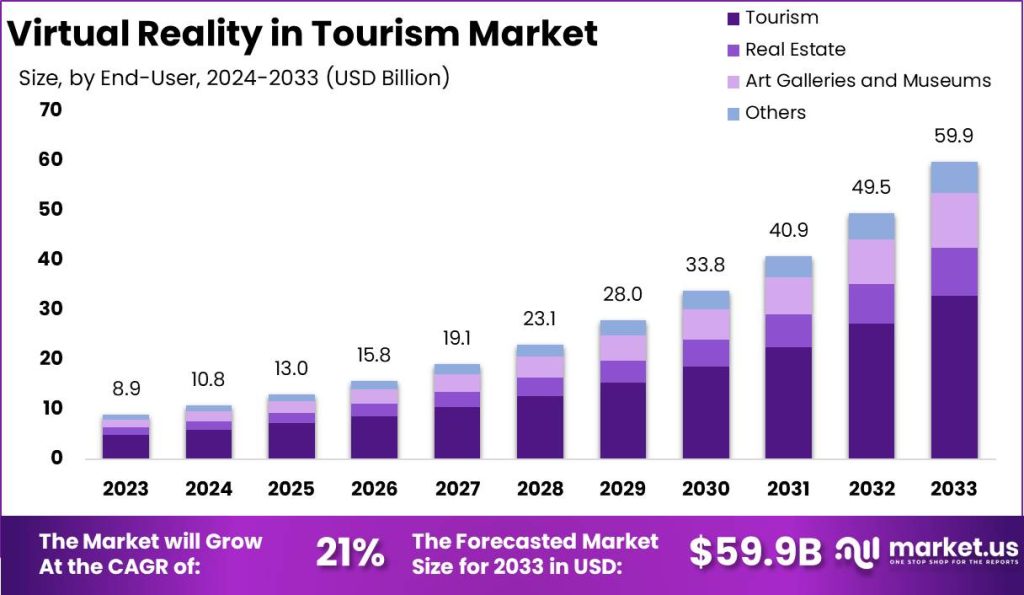
The mass-market availability of affordable and high-resolution products since 2019 has turned VRT from a niche experiment into a multi-billion-dollar industry segment.
History & Evolution of Virtual Reality Tourism
| 2016–2018 | Google Earth VR, The Body VR medical tours, Ascape VR, and early 360° tourism videos |
| 2019–2021 | COVID-19 accelerator With global travel halted, museums (Louvre, British Museum, Van Gogh Museum), tourism boards (Visit Dubai, Tourism Iceland, Peru), and cruise lines rapidly released free or paid VR experience |
| 2022–2024 | Commercial maturation Launch of paid premium experiences (National Geographic VR, BRINK Traveler, Alcove by AARP, Wooorld, Wander), integration of social features, multiplayer tours, and live-guided experiences |
| 2025 onward | Photogrammetry + AI era Mass adoption of Gaussian splat and NeRF-based 3D reconstructions, AI-generated real-time tour guides, dynamic weather/lighting, and hybrid physical-virtual offerings |
Types of Virtual Reality Tourism Experiences
- Pre-recorded 360°/180° 3D video tours
Cheapest to produce, used heavily by tourism boards (e.g., “Virtual Egypt 8K”).
- Photogrammetry-based static environments
Explorable 3D scenes (Matterport-style). Example: BRINK Traveler, Wander.
- Real-time rendered or NeRF/Gaussian splat scenes
Near-photorealistic, infinitely explorable, dynamic day/night cycles (e.g., Unreal Engine 5 Nanite + Lumen).
- Live-guided tours
A real human guide (or AI) leads a group in VR (e.g., Virtuoso Travel + Meta Horizon Worlds)
- Gamified & educational experiences
Assassin’s Creed-style historical reconstructions (Ubisoft), Google Arts & Culture expeditions.
- Fictional & theme-park extensions Star Wars
Galaxy’s Edge virtual preview, virtual Disney park tours.
- Therapeutic & accessibility tourism
Experiences specifically designed for elderly or disabled users who cannot travel physically (Alcove, Rendever).
Current Major Platforms & Apps of VR Tourism
| Wander | Quest, PCVR, Pico |
| BRINK Traveler | Quest, Vision Pro, PCVR |
| Wooorld | Quest, Pico |
| National Geographic Explore VR | Quest |
| Alcove | Quest (AARP-backed senior-focused travel + games) |
| Google Earth VR | SteamVR, revived with 2024 update |
| Horizon Worlds & VRChat | User-created destinations |
| Apple Vision Pro | Environment panoramas + third-party immersive video apps |
| Museum apps | Louvre, Natural History Museum London, Anne Frank House VR |
Business Models
- Free (tourism-board-funded marketing)
- Pay-once apps ($10–$30)
- Subscription (rumored Wander Pro tier, spatial video platforms)
- In-app purchases for premium locations or guided tours
- B2B licensing (hotels offering VR headsets with custom destination menus)
- Live tour ticketing ($15–$80 per person for a 45-minute guided group tour)
Advantages of VR Tourism
- Accessibility: The Elderly, disabled, or low-income can “travel.”
- Sustainability: Zero carbon footprint for the user (Venice, Machu Picchu, Great Barrier Reef).
- Education & preview: Students experience history firsthand.
- Safety Visits: conflict zones, extreme environments, or extinct locations.
- Time travel: Reconstructed historical versions (Ancient Rome by Lithodomos, 1920s Paris, etc.).
- Off-season & 24/7: Access Visit the Northern Lights in summer or the Louvre at 3 a.m.
Limitations & Criticisms of VR Tourism
- Lack of physical sensation: No taste, limited smell, and no real walking long distances.
- Presence paradox: Many users report that hyper-realistic VR can feel eerie or disappointing when minor details break immersion.
- Social isolation vs. connection: Solo experiences can feel lonely.
- High-end hardware cost: While Quest 3S is $299, PCVR or Vision Pro $3,500.
- Data privacy & digital rights: Local communities vs. Western tech companies.
- Employment impact: Fear that local tour guides, drivers, and hotels lose income (mitigated somewhat by evidence that VR increases desire to visit physically).
Technological Enablers of VR Tourism
- Photogrammetry & NeRF/Gaussian splats
- AI upscaling & inpainting
- 8K+ per-eye resolution (Varjo XR-4, Apple Vision Pro micro-OLED)
- Eye-tracking & foveated rendering
- Haptic suits & treadmills (Teslasuit, KatVR, Virtuix Omni One)
- Scent generators (OVR Technology, Feelreal – still niche)
- Body-tracking (HaritoraX, SlimeVR)
Impact on Traditional Tourism
Most studies (WTTC 2024, Skift Research 2025) show VR increases interest in physical travel by 15–40%. Strongest substitution occurs in repeat visits (“I’ve already seen Paris in VR”) or among elderly travelers. Destinations with overtourism actively promote VR alternatives (Santorini, Bora Bora, and Antarctica cruise operators).
Future Trends of Virtual Reality Tourism
- AI tour guides are indistinguishable from humans (voice, appearance, real-time knowledge).
- Full-body haptic suits under $1,000.
- Shared persistent worlds where millions can gather (e.g., a virtual Mecca during Hajj for those who cannot attend physically).
- “VR First” destinations are designed from the ground up to be experienced better virtually than physically.
- Integration with spatial computing glasses (Meta Orion, Apple Glass) → casual all-day use.
- Legal frameworks for “digital visitation rights” to UNESCO sites.
- Smell-o-vision and taste synthesis (early research already exists).
- Therapeutic VR is prescribed by doctors for dementia patients (recreating childhood homes).
Ethical & Societal Questions
- Does VR risk making real travel a luxury for the rich while the masses consume digital simulacra?
- Cultural appropriation concerns when Western startups scan and monetize indigenous sacred sites.
- “Digital divide” tourism—wealthy nations scan the world while poorer ones lack the infrastructure to create their own experiences.
Conclusion
Virtual Reality Tourism has moved from pandemic stopgap to permanent parallel industry. It will not replace physical travel—humans crave novelty, social bonding, and sensory richness that no headset can yet provide—but it has already carved out indispensable roles in accessibility, education, marketing, and sustainability.