Introduction: Why Is the Sky Blue?
Why is the sky blue science explanation is one of the most commonly asked questions in science, yet it often sounds confusing when explained with complex physics. The good news is that the reason the sky appears blue is both logical and fascinating once broken down into simple ideas.
In the first 10% of this article, it’s important to clarify that the science explanation for why the sky is blue has nothing to do with oceans, reflections, or magic. Instead, it comes down to how sunlight interacts with Earth’s atmosphere.
Understanding Sunlight and Color
To understand why is the sky blue science explanation, we must first understand sunlight itself.
Sunlight appears white, but it is actually made up of many colors, each with a different wavelength:
- Red (longer wavelength)
- Orange
- Yellow
- Green
- Blue
- Violet (shorter wavelength)
When combined, these colors form white light. The moment sunlight enters Earth’s atmosphere, physics takes over.
The Science Explanation Behind a Blue Sky
The core why is the sky blue science explanation lies in how sunlight behaves when it hits the gases in the atmosphere.
Earth’s atmosphere is made mostly of:
- Nitrogen
- Oxygen
- Tiny particles and molecules
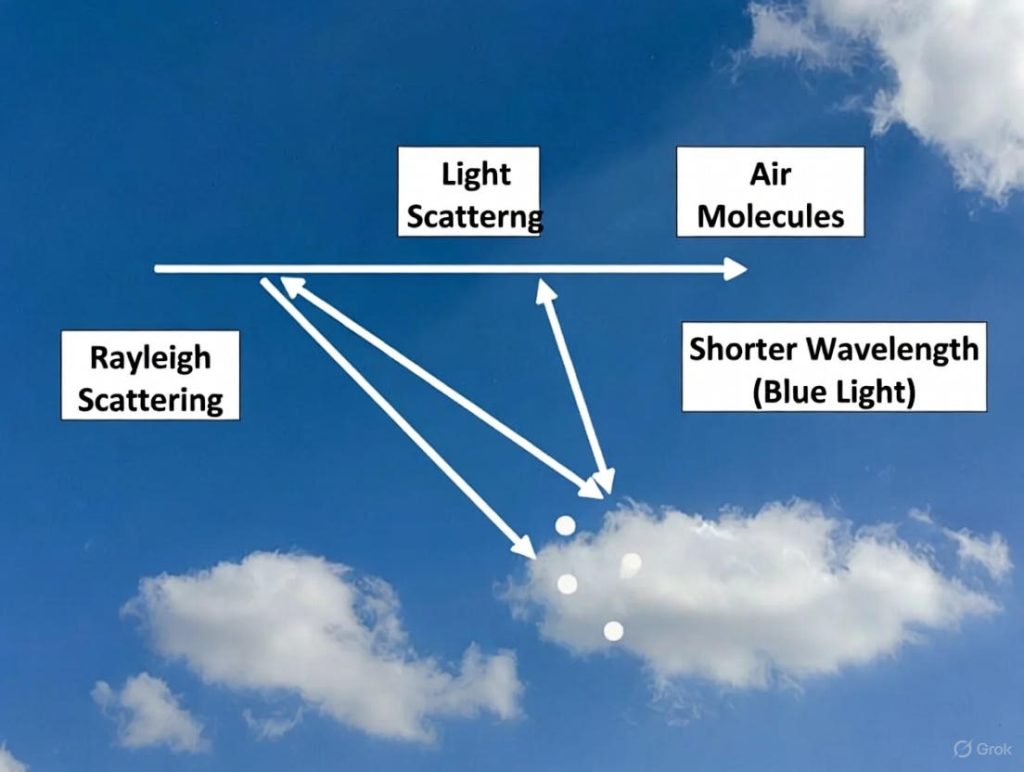
These molecules are much smaller than the wavelengths of visible light. When sunlight strikes them, the light gets scattered in different directions.
This scattering is the key to understanding the blue sky.
What Is Rayleigh Scattering?
The scientific term behind the why is the sky blue science explanation is Rayleigh scattering.
Rayleigh Scattering Explained Simply
- Shorter wavelengths scatter more easily
- Longer wavelengths scatter less
- Blue and violet light scatter the most
Rayleigh scattering occurs when light interacts with particles much smaller than its wavelength—exactly the case in Earth’s atmosphere.
Why Blue Light Is Scattered More
This is the heart of the why is the sky blue science explanation.
Although violet light scatters even more than blue, our eyes are more sensitive to blue light. Additionally:
- The Sun emits more blue light than violet
- Some violet light is absorbed by the upper atmosphere
As a result, the scattered light reaching our eyes is predominantly blue, making the sky appear blue.
Why the Sky Is Not Violet
A common follow-up to the why is the sky blue science explanation is:
“If violet scatters more, why isn’t the sky purple?”
There are three reasons:
- Human eyes are less sensitive to violet
- The Sun emits less violet light
- Upper atmosphere absorbs much of the violet
These factors combine to make blue the dominant visible color.
Why the Sky Changes Color at Sunrise and Sunset
The science explanation also explains why the sky turns red, orange, and pink at sunrise and sunset.
What Changes?
- Sunlight travels a longer path through the atmosphere
- Blue light scatters away before reaching your eyes
- Red and orange wavelengths dominate
This same science explains why pollution can intensify sunset colors.
Why the Sky Looks Different from Space
Astronauts often describe space as having a black sky, even when the Sun is shining.
This fits perfectly into the why is the sky blue science explanation:
- Space has no atmosphere
- No molecules = no scattering
- No scattered blue light = black sky
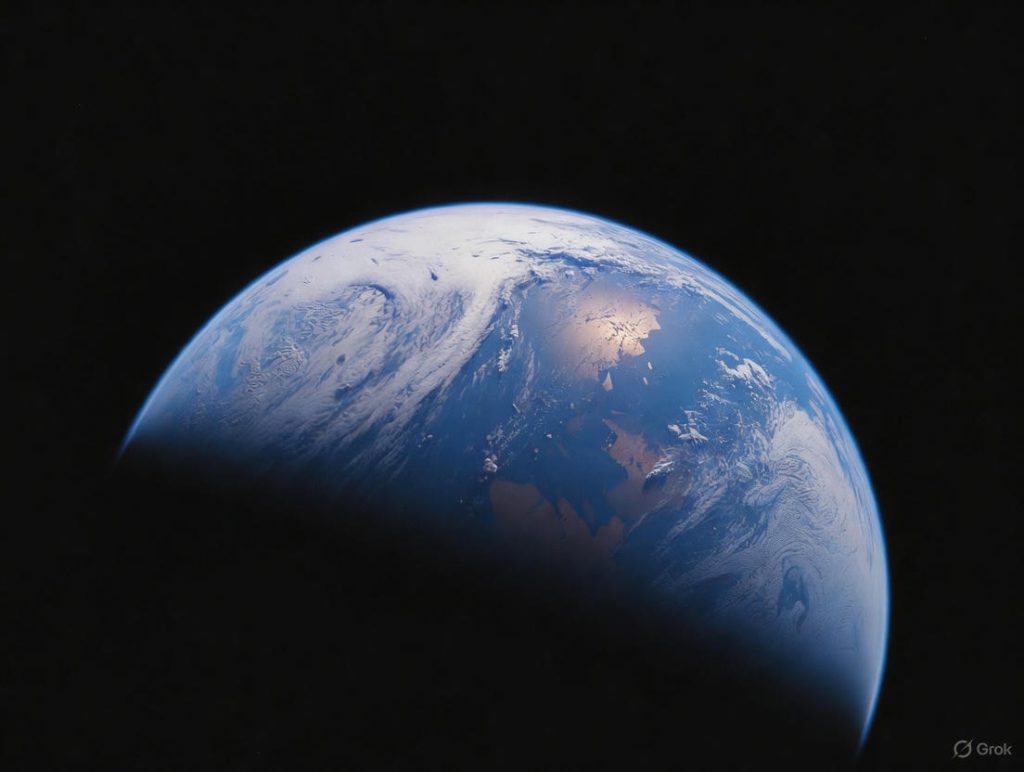
The thin blue layer around Earth highlights how essential the atmosphere is.
How Air, Molecules, and Atmosphere Affect Sky Color
Air density, altitude, and particle size all influence sky color:
- Clear air → deeper blue
- High altitudes → darker sky
- Pollution → paler or hazy sky
The science explanation remains consistent, but conditions can change how intense the blue appears.
How to Explain Why the Sky Is Blue (HowTo Schema Section)
HowTo: Explain Why the Sky Is Blue in Simple Terms
Step 1: Explain that sunlight contains many colors
Step 2: Describe how light enters the atmosphere
Step 3: Introduce scattering by air molecules
Step 4: Explain why blue light scatters most
Step 5: Connect scattering to what our eyes see
This HowTo method makes the why is the sky blue science explanation easy for students and beginners.
Common Myths About Why the Sky Is Blue
Several myths confuse the real science explanation.
Myth vs Fact
- Myth: The sky reflects the ocean
- Fact: The ocean reflects the sky
- Myth: Blue comes from pollution
- Fact: Clean air scatters blue light best
Understanding science facts prevents misinformation.
Real-World Importance of the Blue Sky Science Explanation
The why is the sky blue science explanation has real-world applications:
- Climate science
- Satellite imaging
- Astronomy observations
- Atmospheric monitoring
It helps scientists understand air quality, weather patterns, and planetary atmospheres.
Interesting Facts Related to the Blue Sky
- Mars has a reddish sky due to dust particles
- The Moon’s sky is black due to no atmosphere
- Polar skies can appear darker blue
- Sky color can change slightly with seasons
FAQs: Why Is the Sky Blue Science Explanation (FAQ Schema Ready)
Why is the sky blue in simple words?
Because blue light from the Sun scatters more in Earth’s atmosphere than other colors.
Is the sky blue because of the ocean?
No, the ocean reflects the sky’s color, not the other way around.
Why does the sky turn red at sunset?
Because blue light scatters away, leaving red and orange wavelengths.
Why is the sky darker at high altitudes?
There are fewer air molecules to scatter light.
Is the sky always blue on other planets?
No, sky color depends on atmospheric composition.
Who discovered why the sky is blue?
The explanation comes from Rayleigh scattering, named after physicist Lord Rayleigh.
Conclusion: The Beauty of Science Behind a Blue Sky
The why is the sky blue science explanation proves that everyday sights are often powered by deep and elegant physics. What looks simple on the surface is actually the result of sunlight, molecules, wavelengths, and human perception working together.
Understanding this explanation not only answers a classic question—it also builds appreciation for how science quietly shapes the world around us.