Artificial Intelligence has advanced at a staggering pace, and one of its most transformative embodiments is AI robots. These intelligent machines are no longer confined to science fiction; they now operate in factories, hospitals, offices, and even homes. Their capabilities—from learning and problem-solving to navigating complex environments—have dramatically redefined what robots can do.
In this comprehensive guide, we explore the future of robotics, intelligent automation, robots in industry, humanoid robots, AI-powered machines, robotics for business, smart robots, future of AI technology, evolution, capabilities, applications, and future of AI robots as they continue to reshape industries worldwide.
What Are AI Robots?
AI robots are machines that combine mechanical automation with artificial intelligence technologies, enabling them to:
- Learn from data
- Understand and interpret their environment
- Make decisions
- Interact with humans
- Adapt their behavior over time
They differ from traditional robots, which operate only based on pre-programmed rules. With AI, robots can think, act, and respond intelligently, bringing them closer to human-like cognition.

How AI Enhances Modern Robotics
The intelligence behind these robots is powered by advanced technologies such as:
1. Machine Learning (ML)
ML allows robots to learn patterns from experience. They get better over time, similar to how humans learn through repetition.
2. Computer Vision
This gives robots the ability to “see” and interpret visual information—detecting objects, reading labels, recognizing faces, or navigating complex spaces.
3. Natural Language Processing (NLP)
NLP lets robots understand, interpret, and respond to human language, making communication smoother and more intuitive.
4. Reinforcement Learning
Robots learn through trial and error, receiving rewards for completing tasks correctly, much like training a pet.
5. Deep Neural Networks
These enable advanced decision-making, pattern recognition, and predictive capabilities.
Types of AI Robots in 2025
AI robots come in various forms, each built for specific environments and tasks.
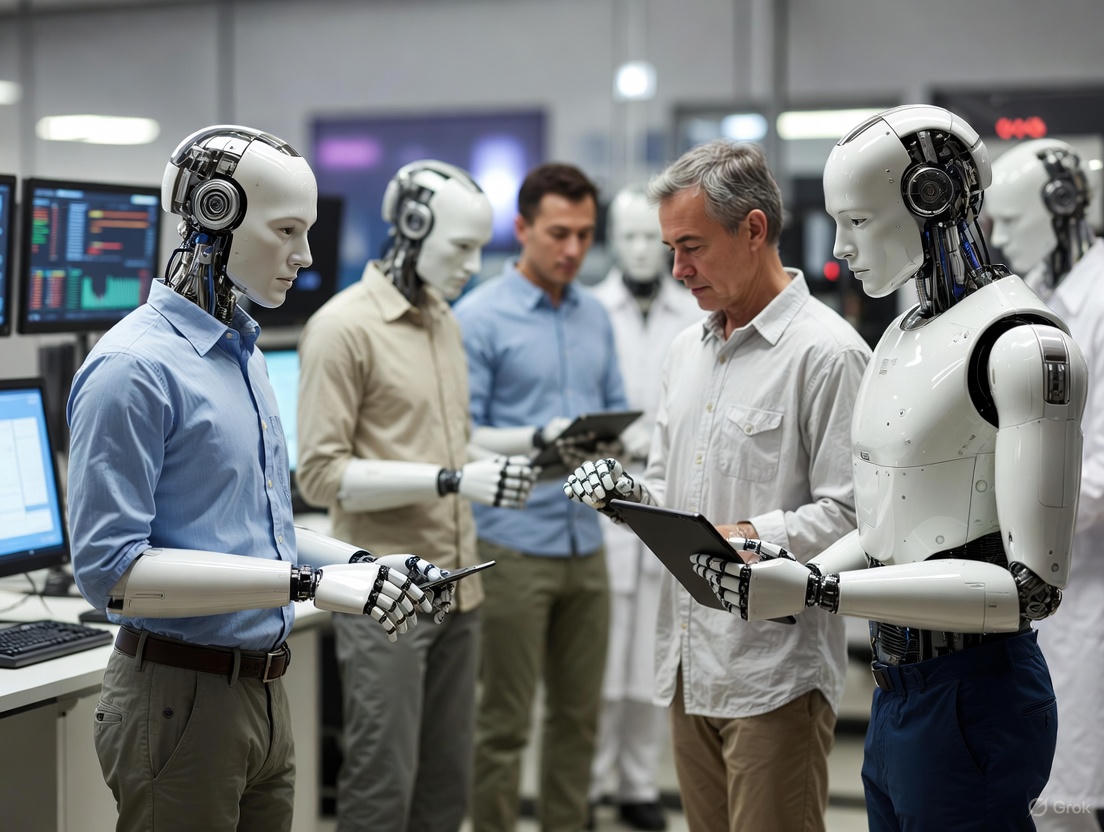
1. Humanoid Robots
These robots resemble humans in appearance and behavior. They walk, speak, and interact like people, often used in customer service, elderly care, and research labs.
Common examples:
– Social companion robots
– Customer-service androids
– Dexterous humanoid assistants
2. Industrial AI Robots
Used in manufacturing and production, these robots automate repetitive or dangerous tasks. AI helps them optimize efficiency, reduce errors, and work collaboratively with human employees.
Examples:
– Smart assembly robots
– Quality-inspection robots
– Robotic welders and painters
3. Service Robots
Service robots assist in hospitality, retail, offices, and homes. AI enables tasks like navigation, responding to customer queries, and providing recommendations.
Examples:
– Hotel concierge robots
– Retail assistants
– Automated delivery robots
4. Medical AI Robots
AI-powered medical robots play an essential role in diagnosis, surgery, and patient care.
Examples:
– Robotic surgeons
– Rehabilitation robots
– Autonomous hospital assistants
5. Autonomous Mobile Robots (AMRs)
These robots independently navigate and transport goods using AI mapping, making them popular in warehouses, airports, and logistics hubs.
6. Educational & Research Robots
AI robots help students learn programming, engineering, and robotics. They are also widely used in research institutions for advanced experiments.
Best AI Tools 2025: Top AI Apps for Productivity, Creativity & Automation
Applications of AI Robots Across Industries
AI robots have moved beyond novelty and become essential tools in multiple fields.
1. Manufacturing
AI robots increase production speed, maintain precision, and work around the clock. They reduce errors and ensure consistent quality.
Key roles:
- Assembly and packaging
- Quality inspection
- Material handling
- Predictive maintenance
2. Healthcare
AI robots assist doctors, nurses, and patients alike.
Functions include:
- Robotic surgeries
- Medication delivery
- Patient monitoring
- Lab automation
Their accuracy reduces risks and supports medical staff during high-pressure operations.
3. Agriculture
AI-powered farm robots improve efficiency and harvest yield.
Tasks include:
- Crop monitoring
- Automated harvesting
- Soil analysis
- Weed detection
These innovations help meet increasing food demands sustainably.
4. Retail & Hospitality
AI robots improve customer experience and streamline operations.
Examples:
- Robot waiters
- Automated check-out systems
- Inventory management robots
- Smart concierge services
5. Logistics & Warehousing
AI robots ensure rapid and accurate order fulfillment.
Roles include:
- Sorting packages
- Managing inventory
- Delivering goods in warehouses
- Autonomous delivery vehicles
6. Education
Robots assist in teaching coding, language learning, and STEM activities, making education more engaging and interactive.
Benefits of AI Robots
The adoption of AI robots brings enormous advantages:
1. Increased Productivity
Robots never tire, allowing continuous operation.
2. Precision and Accuracy
AI reduces the chance of human error, especially in complex tasks.
3. Cost Savings
Long-term operational costs are lower compared to manual labor.
4. Enhanced Safety
They handle hazardous tasks, reducing workplace injuries.
5. Improved Customer Service
AI robots deliver fast, consistent, and personalized responses.
6. Innovative Problem Solving
Robots equipped with AI can analyze data and make intelligent decisions.
Challenges and Concerns
As powerful as AI robots are, they also introduce challenges:
1. High Initial Costs
Advanced robots require significant investment.
2. Job Displacement Fears
Some workers worry about robots replacing human roles, although new jobs also emerge.
3. Ethical Issues
Questions arise around responsibility, privacy, and robot autonomy.
4. Technical Limitations
Robots still struggle with emotional intelligence and unpredictable environments.
5. Cybersecurity Risks
AI systems can be vulnerable to hack attempts if not properly secured.
Future of AI Robots: What to Expect by 2030
The future of AI robots looks incredibly promising. Upcoming advancements will make robots more adaptive, intelligent, and integrated into everyday life.
Key predictions for the next decade:
- Household robots will become common in cleaning, cooking, and elderly care.
- Humanoid robots may join workplace teams, performing cognitive tasks.
- Emotionally aware robots will interact more naturally with humans.
- Fully autonomous factories will operate with minimal human oversight.
- New jobs will emerge in robot training, maintenance, and ethics management.
AI robots are set to become as essential as computers and smartphones are today.
FAQs About AI Robots
1. What are AI robots?
AI robots are intelligent machines that use artificial intelligence to perform tasks autonomously or semi-autonomously.
2. How are AI robots different from regular robots?
Traditional robots follow pre-programmed instructions, while AI robots learn, adapt, and make decisions using advanced algorithms.
3. Where are AI robots used today?
They are used in healthcare, manufacturing, logistics, agriculture, education, and customer service.
4. Are AI robots safe?
Yes, when programmed and monitored correctly. Built-in safeguards ensure safe operation around humans.
5. Will AI robots replace human workers?
Robots may replace some repetitive jobs but also create new opportunities in tech, maintenance, and supervision.
6. How will AI robots evolve in the future?
Future robots will be more autonomous, emotionally aware, and seamlessly integrated into daily life.
Conclusion
AI robots represent one of the most significant technological shifts of the 21st century. They are no longer futuristic ideas but practical tools transforming industries, improving lives, and powering economic growth. As technology continues to evolve, AI robots will become smarter, safer, and more integrated into human society—ushering in a future where humans and robots work together seamlessly.